 February 2002 (a long time ago) I learnt that Chris Sladden was putting together a Grand Canyon trip (a chartered commercial trip with Flagstaff based ‘Outdoors Unlimited’) – it didn’t take much prevaricating to put my name down.
The River
For around 270 miles, from Lees Ferry to Lake Mead, the Colorado cuts through the giant uplifted land mass of northern Arizona, exposing successive rock strata (down to the 1.7 billion year old Vishnu Schist) during it’s passage. The canyon reaches a giddy depth of one mile. The river itself has an average width of 300’, and reaches over one hundred feet in depth. At the time of our Journey (May) the river levels were a low to medium flow of around 400 cumecs (varying during the day with the releases from Lake Powell) The temperature was not too hot, the sky was a continuous blue and the water clear (not the muddy red silt laden flows that give the Colorado its name). Everything about the Grand Canyon is big – and it takes a few days to become adjusted to the scale.
 The river drops around 1700’ during its journey – an average of around 8’ per mile, but most of this fall is taken up by the 165 rapids which account for less than 10% of the 270 miles. With a 15 day float, we would encounter an average of 11 rapids each day. The majority of these are big-water read-and-run grade 2 to 3+ wave trains, perhaps with one or two easily avoided holes and pour-overs – ‘big water = big lines’ holds true for most.
More often than not the rapids are wide open and you can decide how big you want to go – aim for the hair line through crashing waves and holes or cut the top laterals and aim for the smaller flows well away from the action. Indeed, the majority are so friendly that it wasn’t long before everyone was choosing to ‘go big’ dropping into the wave holes just for the crack.
Some rapids, up to grade 4+, however, require a little more respect and scouting (e.g. Hance, Crystal, Granite, and Lava). Indeed, the latter appeared quite daunting from a view point some 200’ above the river – meaty holes, fearsome laterals, huge crashing waves and a narrow line through these on river right. Over the ‘flats’, the river still swirls along at around 4 mph - making the sections between rapids both relaxing (floating along staring at the awesome canyon walls towering above) and entertaining (try waltzing in the same whirlpool as an 18’ oar raft!).
A Canyon Day
The Crew from ‘Outdoors Unlimited’ were a tireless and highly professional bunch that organised camp routines and practices that kept all healthy and well fed and ensured that there would still be fresh steaks and vegetables, and ample grog even on the 15th day (with no re-supplying feasible). Days floated by with the river, there were too many experiences and incidents, too many hikes and rapids, to recount in an article such as this. Perhaps it is best to describe a typical ‘Canyon Day’.
 The Coffee Conch goes at around 5:30 – by this time it is light, although the sun will not have hit the high canyon walls above. But the Canyon Wrens descending call (such a big sound for such a small bird) will have heralded the day and dragged me from a sound sleep before the Conch is blown. (5:30 sounds early now, but on the Colorado we had soon ditched our watches and were operating entirely on Conch-Time)
I crawl out of my bedding roll (stuffing it directly into a dry bag before scorpions have had a chance to invade) and take a wake-up dip in the cold river – emerging refreshed but blue. I Wander down to the camps kitchen area to pour my first bucket of coffee and, perhaps, a slice of melon. If the urge is on me I sip the coffee while chatting in the ‘Groover line’ – with 33 campers there is almost always a queue to use the ‘facilities’ (ammo box behind a rock) in the morning.
By my second bucket of coffee the breakfast conch sounds – muffins, hash browns, bacon and a couple of over-easy eggs (or perhaps pancakes and syrup) and I’m set for the day. Pack up the dry bag and take it down to the communal tarp. By 7am the tarp holds a mountain of gear ready for loading to the rafts. I don the paddling kit and spend a few moments washing the red Colorado sand from my kayak.
“Hey y’all - last call for the boot bag” – 33 pairs of boots or sandals for the side canyon hikes are hastily shoved into the communal bag.
“Last call for water” - those who haven’t already done so, fill water bottles from the filtered water container. It’s going to be another hot day; buckets of filtered and treated river water will be needed to keep all hydrated
“Last call on the Groover” - The line for the ‘facilities’ should be diminished by now, the rocket box is normally the last bit of kit to be packed away and loaded. For those unfortunate enough to have missed the call – there’s always the ‘Day Tripper’, a small ammo can with all the essentials. Park rules - what you take into the canyon has to come out with you.
By 07:30 we are loaded and set off down the river. We paddle for may be an hour before pulling over at a beach. A hike is planned this morning – perhaps 3 hours – returning to the river hopefully before the sun has become too fierce. It’s still early in the year, but day time temperatures will be 300 to 350C. The Boot bag is broken open, we fill two water bottles each, don hats and sun screen and set off on the trail up a side canyon. The water sculptured rock closes in on us and we soon lose sight of the Colorado 500’ below us. The trail continues precariously along the steep canyon sides, a Mule deer cocks its head at our passing but is undisturbed; lizards scamper away from our feet. We climb on until we reach a waterfall at the head of the canyon.
We can go no further – a dip in the pool below the fall washes away the sweat. Scarlet Monkeyflowers and ferns cling to the canyon wall drinking in the spray. Many of the cactus are flowering at this time of the year. We pass around the GORP (a tub or granola, oats, raisins and peanuts) and set off back down the trail to the boats. A couple of crew missed the hike and have prepared lunch – a table groans under ingredients for tortilla wraps.
 We have about 15 miles of paddling to cover in the afternoon. Within a few minutes we reach the first wave and jostle to catch it on the fly. The river flows are big and fast, it’s not always easy to catch the waves – but when it happens, particularly where the wave is steep and crashes, the rewards are immense.
 Occasionally we find an eddy-served wave and let the rafts drift on ahead of us while we pause for play. We reach a larger rapid and clamber up the bank for a vantage point to inspect. This one is long, technical and, of course, big. The line is discussed – not always easy to discern in the maelstrom of white. Break out behind the first evil pourover into the ‘duck pond’ (Ha ha!), then move left through crashing waves away from two huge holes – cut back right for a ride down the wave train. With dry mouths we peel out and attempt to hold the line (which looks so different at river level). All through – we eddy out and watch the rafts – hoping for a flip – but just whoops of triumph as they all make it through.
We pull into camp at around 5pm, form a ‘baggage line’ for unloading the rafts and then explore the beach for a suitable ‘sleeping pod’ (an area of sand between boulders on a river moraine) and layout our tarp. Beer nets have been floating behind the rafts for the last hour, the Buds are chilled. A dip to clean off and a time for quiet reflection or for exploring the environs, chasing Desert spiny Lizards or trying to coax a Chuckwalla out from a crevice in the rock. A game of Horseshoes is underway.
 The Conch sounds for snacks (crackers, dips, olives, fruit). A few more beers and the conch sounds again for dinner (tonight, trout and trimmings). A fire is lit, Will gets out his guitar, and we spend an hour or two before crawling into our bedding roles. The moon is bright, the stars awesome, another great Grand Canyon day – there are plenty to follow.
A ‘trip of a lifetime’ without a doubt – awesome, mellow, chilled.
 Thanks to Chris Sladden for putting it all together, to the crew from Outdoors Unlimited and to all the ‘punters’ for the superb company.
(Published in "Canoeist" Magazine August 2004)


 Frazzled and travel weary we finally made it to Fawlty Towers backpackers lodge for a few hours rest. Here Chas and I (later to be known as the ‘old crocs’) met Bryan McKenzie from Canada, the third and final paying member of the trip.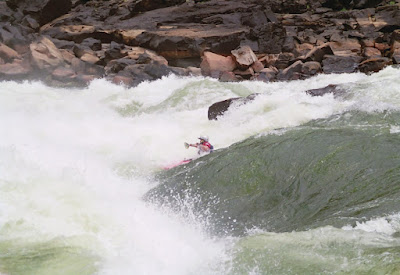
 The following two days were spent re-running sections of the gorge (1-13, 11-21), returning to Fawlty Towers each night. We were beginning to get used to the power of the Zambezi, it’s whirlpools and boils, the rapids and their lines. #4 and #7 continued to give me pastings, and the ‘Catchers Mitt’ caught me once but we were beginning to relax and enjoy the other aspects of the gorge, its scale, beauty and wildlife. Baboons, Vervet Monkeys and Rock Dassies scampered along the banks, Black Eagles and Kites soared above us. We were even getting used to the climbs out of the gorge each day.
 While crocodiles are around in some of the pools within the Batoka Gorge and, indeed, we had seen one or two, these are generally small and few in number. However, for the final 25km push from rapid 25 to Moemba Falls Crocs become more numerous. On this day the four remaining kayakers (Chas, suffering a dodgy stomach, was lounging around in the raft sipping Dioralyte and iodine cocktails) adopted a different approach to the previous days. We paddled fast, as a tight group, through the long slack water sections, trying to give the impression that we were a healthy herd, continually scanning the banks for signs of crocs, ready to "paddle like f . . . ." if we saw one slip into the water. We took breathers at each of the fourteen rapids along the way. In reality, we only saw three crocs all day – but I must confess to a slight (and, I’m sure irrational), raising of the heart beat all day!
 Easter 2002, I plugged into Chas’s Scotland week
  For the 4 days I spent with this lot there proved to be more beer than water. Consequently, our paddling was limited to those runs that still work when rivers are low. The Etive, Roy Gorge, Fechlin and Spean Gorge, however, all provided for some great grade 3 to 4+ entertainment – lots of tight technical paddling, gnarly holes, drops and falls with names like ‘Head Banger’, ‘Multiple Choice’, ‘The Brothers Grim’, ‘The Constriction’, ‘Fairy Steps’, ‘Witches Cauldron’, ‘Letter box’, ‘Crack of Doom’, ‘Crack of Dawn’, and ‘Big Mans Falls’ (to name a few).
 These runs are all short, very scenic, and characterised by blind corners and drops often requiring bank inspection and protection – and there are a few nasty undercut 5’s that are best portaged. We had plenty of back-loops, a few swims and scraped knuckles but Chas still insisted on describing most runs as ‘A Stroll in the Park’


 The Sun Kosi flows East from Kathmandu, forming the watershed for most of Eastern Nepal. It drains the highest mountains in the world before emerging into the Northern plains of India where it joins the Ganges.
 The volume of water increased as each major tributary joined us to reach around 800 Cumecs at the Jungle Corridor. This was BIG volume water - huge wave trains, swirling eddies, whirlpools, bus swallowing holes and grabby 'funny water'.
 The Tamur flows into the Sun Kosi shortly before Chatra. Having completed the Sun Kosi we bussed up to Mulghat and spent a day running the 25kms back down to the confluence. This proved the best days paddle I think I have ever had - 5 hours of almost continuous big volume grade 4/4+ rapids. About 45 rapids in all, most 'read and runnable' but some requiring careful scouting.
 We finished the trip with a another day in Kathmandu - washing the sand from our kit/hair, eating fine steaks, spending rupees and lapping it all up before we had to return to our real lives. I had crammed a load of fun, a wealth of experience and memories into a short two weeks I would advise anyone to do the same! You don't have to be a 'hair boater' to paddle in Nepal.





