
Any paddler should know what the Zambezi is like .. it features in many of the mags and on many of the videos. Often billed as the best white water run on the planet - big warm water, huge bus swallowing holes, evil whirl pools, classic surf waves … and crocodiles! – how the hell did I end up there?
Well, thanks to my family, I was up for a trip in 2002 somewhere and all I had to do was identify the location. Mmm .. Nepal? .. I would love to go there again. Chas was selling his IZ230 on Mark Rainsley's web site message board .. I indicated that I might be interested for a ‘Nepal in the Fall’ trip. People then started to butt in:
Mark asks .. "What are you paddling this time Graham, … the Zambezi is good in October"
I reply, with no uncertainty, "The Zambezi is beyond me"
Mark points out that, according to Si, it’s easier than the Fu in Chile
Chas says .. "the IZ230 is sold, but can I come to Nepal/Zambezi with you"
Then I watch the video "Wicked Liquid" again (and again, and again) until, eventually, I’m beginning to visualise me there, surfing those big waves just like a pro.
Of course, I also received much sound advise from certain members of Ringwood Canoe Club – generally on the insanity theme. (These same members were heard planning the divvying-up of my kit should I not return!)
I started to collect some information …There was an outfit called TheZambezi.com, set up last year by Muzza (NZ) and Andrew (Sven) Bolton (UK) who had already run 5 or 6 kayak trips down the Zambezi. …. October is the end of the dry season out there, the river will be at its lowest (oh, great, nice and easy).
So we went, Chas and I, flying out to Livingstone (via Joburg) at the end of October. Those kind people at British Airways taking our Kayaks for nothing (although we were severely limited with our weight allowance of 23Kg)
Sitting in the departure lounge I started to read the ‘lonely planets’ guide to Zambia. This included a special section on Adrenaline Sports …
"Down stream from Victoria Falls, the rapids of Batoka Gorge can be run by kayaks … if you know what you’re doing (like really know)"
Did I ‘really know’ what I was doing? – of course, the author wasn’t a paddler, what did he know!, besides, Chris Wheeler had told me it’s big … but easy (but then, he would!). I read on ….
"August to October : the main rafting period. Water continues dropping. The later the season, the bigger the rapids, and the braver the rafters"
That can’t be right can it?, the rapids get bigger when the river level drops? I’m already through passport control – there’s no turning back and I obviously don’t know what I’m doing …….
Having flown overnight and made the connection in Jo’burg for our onward flight we arrived at Livingstone, Zambia, early afternoon. Watching the unloading of the plane we were relieved to see the boats had also made it. The customs official was busy on her radio as Chas breezed through, but she finished her call and raised her eyes just as I was approaching the door carrying the kayak. She wanted a payment of around £350 deposit to bring the boat in to Zambia – this would be returned to me when I left the country – but as 2.3 million Kwathca! Fortunately Sven had arrived to pick us up and, after some debate, managed to sort things out.
 Frazzled and travel weary we finally made it to Fawlty Towers backpackers lodge for a few hours rest. Here Chas and I (later to be known as the ‘old crocs’) met Bryan McKenzie from Canada, the third and final paying member of the trip.
Preparation and Training
Of course, before tackling a river like the mighty Zambezi it’s important to prepare and train adequately – to become a perfectly honed and fit paddling machine. Consequently, Chas and I had grabbed a few hours at Woodmill weir during the summer – eventually developing skills sufficient to stay upright, and even throw a few ends.
This training regime was supplemented by extended bath times - following (what later proved to be sound) advise from fellow paddlers "for the Zambezi – practice holding your breath" I ditched the shower in favour of deep baths with plenty of bubbles (to simulate the Zambezi's aerated water) and a stop watch. – at least I smelt good.
Final preparation was to be undertaken on the evening of our arrival. This comprised a Booze Cruise on the Upper Zambezi (countless Mosi beers while watching elephants, Hippo, Impala and Zebra, etc. from the deck of the ‘African Queen’) followed by a drinking session at ‘Hippos Bar’ where Bryan, Chas and I got to know our two guides Sven and Ben Brown.
The first Run of Batoka Gorge 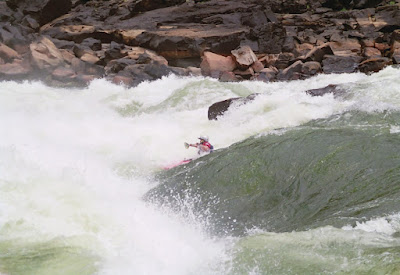
The after effects of the long flight and of the boozy booze cruise the evening before was, perhaps, not the best grounding for our first run of the 24km Batoka Gorge (Rapids #1 to 18). We signed the indemnity forms over a hearty breakfast at Muzza’s place, then took the long climb down the gorge to the ‘Boiling Pot’ at the foot of Victoria Falls – this has to be the most awesome river put-in on the planet.
My knees were trembling when we reached the bottom, where the porters had left our boats. Rapid #1 "back against the wall" was directly ahead of us – here the 100m deep gorge pulls a sharp 90 degree turn, causing water to pile into the wall. We all made the ferry, avoided the wall pasting and I began to relax. The next two rapids "Between Two Worlds" and "Bits and Pieces" were relatively straight forward, and there were long pools between each of the rapids … hey .. this is going to be OK. But …
Within a few more minutes we reached #4 "Morning Glory" and the first of the major rapids. We got out and looked at this one – a long rapid with a couple of prominent holes. The line was discussed – eddy out at top right, skirt the first hole, power to the left of the wave train, line up for the bottom hole and, hopefully, get spat out into the pool below. I got the first bit right but, needless to say, the rest of the rapid I tackled in an inverted position – I rolled up spluttering at the bottom, conscious that a big croc lived in the pool below, not quite sure what had happened but knowing that I had seriously misjudged the power of the water.
No harm, let’s try the next - #5 "Stairway to heaven", billed as the largest commercially rafted rapid in the world. Here a steep ramp runs between a 15’ pour-over on the right and the infamous ‘Catchers Mitt’. Disappearing over the horizon line, heart in mouth, I was confronted with more of the white stuff than I could previously have imagined – a huge, seemingly impenetrable mountain of water. "Look for the window"…someone must have pulled the curtains…no, there it is, power through, wow.. still upright… awesome.
#6 "The Devil’s Toilet Bowl" was next (who makes up these names?) – a steep drop skirting a mean hole, and then …
#7 "Gulliver’s Travels" the longest (650M) and most technical of all the Zambezi rapids. We stood on the bank for a long time here trying to fix the line in my mind .. eddy out right, ferry centre, skirt the Diagonal, miss the crease, catch the tongue flowing river right, just bypassing a crashing hole, and then… into the ‘Land of The Giants’ – a huge crashing wave train and some fairly inevitable quiet time here. Not an easy rapid, this one – it’s length, the string of moves you have to pull together and the punishing (but exhilarating) giants was amazing.
#8 gives you the options of the mighty ‘Muncher’ in the centre, or the "Star Trek" run (going boldly where no man has gone before) – or a sneak route between, if you get it right!
#9 "Commercial Suicide" – no way – not for paddlers of our ability anyway, although we watched Ben breeze it while we walked
#10 – a comparatively easy wave train but with the intimidating name of "Gnashing Jaws of Death"!
#11 "Overland Truck Eater" is, at higher levels, a unique barrelling and surfable wave but, sadly, at these levels it proved to be a big hole followed by some angry boils that toyed with me for ages, tail spinning, rolling and eventually releasing me unscathed.
#11B, 11C, 12A and, finally, we had reached the infamous 12B (the middle of the ‘Ugly Sisters’), said by many to be the finest play wave in the world. At the low levels now, however, it was not at its best – very steep, crashing and unforgiving. Disappointed that I didn’t manage to get on the wave at all on this first occasion (Later in the week I was rewarded with a few really exhilarating, but short, rides here)
#13 "The Mother" was a comparatively simple yet huge wave train (big air here when my boat left the water). But 14 through to 18 passed in a blur – punch drunk and battle weary I was, at this stage, running on empty and autopilot – crashing through ‘The Narrows’, ‘Washing Machine’, ‘The Terminators’, ‘Judgement Day’ and, even, ‘Oblivion’ without major mishap (although plenty of tip-ups).
We arrived at the get out knackered but elated, to start the half-hour near vertical climb out of the gorge to camp at the top. A load of paddling experiences and adrenaline in just one day! It was hot and muggy as we pitched our tents. Thunderstorms accompanied our steaks and beer. Despite the hard basalt ground I drifted off to sleep re-running Gullivers Travels – but, in my dreams, I had a perfect line!
Back for more punishment
The following two days were spent re-running sections of the gorge (1-13, 11-21), returning to Fawlty Towers each night. We were beginning to get used to the power of the Zambezi, it’s whirlpools and boils, the rapids and their lines. #4 and #7 continued to give me pastings, and the ‘Catchers Mitt’ caught me once but we were beginning to relax and enjoy the other aspects of the gorge, its scale, beauty and wildlife. Baboons, Vervet Monkeys and Rock Dassies scampered along the banks, Black Eagles and Kites soared above us. We were even getting used to the climbs out of the gorge each day.
A day of rest and recovery – catching up on sleep and chilling at Fawlty Towers and we were ready for the ‘Multi-Day’ Us 5 paddlers were now joined by Davis, rowing a gear raft, and we took three days to paddle from the Boiling Pot, down through the gorge and to Moemba Falls, some 25kms beyond the last of the numbered rapids (#25). The awesome river running was now complimented by beautiful river beach camping, excellent camp cuisine, classic African dawns and dusks, the Zambian trots! and paddling through Croc. Country ….

Paddling as a ‘healthy herd’

While crocodiles are around in some of the pools within the Batoka Gorge and, indeed, we had seen one or two, these are generally small and few in number. However, for the final 25km push from rapid 25 to Moemba Falls Crocs become more numerous. On this day the four remaining kayakers (Chas, suffering a dodgy stomach, was lounging around in the raft sipping Dioralyte and iodine cocktails) adopted a different approach to the previous days. We paddled fast, as a tight group, through the long slack water sections, trying to give the impression that we were a healthy herd, continually scanning the banks for signs of crocs, ready to "paddle like f . . . ." if we saw one slip into the water. We took breathers at each of the fourteen rapids along the way. In reality, we only saw three crocs all day – but I must confess to a slight (and, I’m sure irrational), raising of the heart beat all day!
We pulled in to the final take out above Moemba Falls, cleared baboon shit from the rocks to sit and stare at the gnarly water of Lower Moemba. . While Ben, the only one with any inclination to run these falls, scouted the lines and rehearsed his strokes, I again returned to the ‘did I really know what I was doing?’ question. Yes, I think I did. I took some beatings, I took a swim, but I had enjoyed everything. Nyami Nyami (the Zambezi river god) had, perhaps, played with me a little but, in the end, had granted me a safe passage and a fantastic trip.
If your comfortable on grade 4 and have a really dependable roll then the Zambezi has to be an ‘ultimate’ trip. TheZambezi.com did us proud. Sven and Ben (and Muzza and Donna) looked after us well, both on and off the water, they organised all the logistics so that all we had to do was enjoy the paddling and the gorge.
If your up for it - get to it
(Published in "Canoeist" Magazine February 2003)
 The Autumn of 2005 proved one of the best seasons for ages. I was on Dartmoor almost every Sunday for 3 months – it was shocking to find that, at this time of year, I visit Dartmoor far more often than Fordingbridge or Ringwood and I dread to think what it has cost me in petrol.


 After a short stop at Dancing Ledge we approached Aldhelm’s head. Despite the tides there seemed to be white horses – the promise of some play at the overfalls there, but, sadly, nothing of consequence and so on to a late lunch at Chapman’s Pool.
 It seemed idyllic and the wind had dropped but a few problems then arose.
  We were at Swanage by 3pm, having hardly noticed the distance paddled – quick Ice creams and we were offSo this is what Sea Kayaking is all about – OK, certainly in the conditions we had, it does not provide an adrenaline fix, but it does open a whole new and changing world to explore while getting some needed exercise. I’m looking forward to the next time I can get out in my sea boat.
 I knew that the river offered some fairly continuous and high-volume class 3-4+ rapids in June - just after Andy’s exams were due to finish. I also knew a few paddlers that had been out there and asked them what the likelihood was of the two of us finding other paddlers to hook up with. They were doubtful, but Water By Nature ran trips out there with everything laid on. More £’s of course, but who cares – we are off paddling.
 Clear blue skies and growing temperatures joined us for a mellow grade 2 warm-up in the morning – a chance for getting accustomed or re-accustomed to big-volume paddling. After a couple of hours clouds brewed up - then thunder, lightening and hail as we hit the lunch stop. We sheltered under an old steel football stand at a long-forgotten and abandoned football field - shivering.


 The river drops around 1700’ during its journey – an average of around 8’ per mile, but most of this fall is taken up by the 165 rapids which account for less than 10% of the 270 miles. With a 15 day float, we would encounter an average of 11 rapids each day. The majority of these are big-water read-and-run grade 2 to 3+ wave trains, perhaps with one or two easily avoided holes and pour-overs – ‘big water = big lines’ holds true for most.
 The Coffee Conch goes at around 5:30 – by this time it is light, although the sun will not have hit the high canyon walls above. But the Canyon Wrens descending call (such a big sound for such a small bird) will have heralded the day and dragged me from a sound sleep before the Conch is blown. (5:30 sounds early now, but on the Colorado we had soon ditched our watches and were operating entirely on Conch-Time)
 The water sculptured rock closes in on us and we soon lose sight of the Colorado 500’ below us. The trail continues precariously along the steep canyon sides, a Mule deer cocks its head at our passing but is undisturbed; lizards scamper away from our feet. We climb on until we reach a waterfall at the head of the canyon.
  We have about 15 miles of paddling to cover in the afternoon. Within a few minutes we reach the first wave and jostle to catch it on the fly. The river flows are big and fast, it’s not always easy to catch the waves – but when it happens, particularly where the wave is steep and crashes, the rewards are immense.
 Occasionally we find an eddy-served wave and let the rafts drift on ahead of us while we pause for play. We reach a larger rapid and clamber up the bank for a vantage point to inspect. This one is long, technical and, of course, big. The line is discussed – not always easy to discern in the maelstrom of white. Break out behind the first evil pourover into the ‘duck pond’ (Ha ha!), then move left through crashing waves away from two huge holes – cut back right for a ride down the wave train. With dry mouths we peel out and attempt to hold the line (which looks so different at river level). All through – we eddy out and watch the rafts – hoping for a flip – but just whoops of triumph as they all make it through.
 The Conch sounds for snacks (crackers, dips, olives, fruit). A few more beers and the conch sounds again for dinner (tonight, trout and trimmings). A fire is lit, Will gets out his guitar, and we spend an hour or two before crawling into our bedding roles. The moon is bright, the stars awesome, another great Grand Canyon day – there are plenty to follow.
 Thanks to Chris Sladden for putting it all together, to the crew from Outdoors Unlimited and to all the ‘punters’ for the superb company.





